For adult children
The conversation you keep meaning to have, made simple.
Most adult children worry about what happens when their parents can't manage things anymore. Most parents want to spare their kids the scramble — they just don't know where to start. This is where to start.
Tip: open a vault yourself first. Once you've used it for your own affairs, suggesting it to your parents is a much easier conversation.
Three moments to think about
When it matters, you're not starting from zero.
Now
Your parents are healthy. You don't think about this. But you've watched friends go through the scramble — finding the password, the safe deposit box, the lawyer's name — and you know it's hard. Now is when the conversation is easy.
Soon
A health scare, a move, a refinance. Suddenly the question of "where is the will" matters. If your parents have a vault you can access read-only, the answer is: right here, updated last month.
Eventually
When the time comes, you're not searching. You're acting. The will is in the vault. The accounts are listed. The advisor's contact card is pinned. You know what's there because you've seen it before.
What it does for you
Six things you didn't know to ask for.
Visibility — when they share with you
Read-only access to what your parent has organized. No surprises, no scrambling later.
An easy conversation starter
Most parents want to do this. They just don't know where to start. Sending them this site is a low-pressure way to bring it up.
You can help them stay current
See when documents need updating. Nudge them when reminders fire. Be the gentle accountability without being pushy.
Multiple kids, one source of truth
Siblings can all be designated readers. No "did mom tell you where the…" texts. Everyone sees the same thing.
Privacy preserved
Your parent decides what to share and when. Their vault, their keys. We can't read it either.
Their advisor stays in the loop
If they work with a financial advisor or attorney, that person is in the same vault — pinned contact card, document requests, coordination.
Shared with you, controlled by them
You see what they share. Nothing more.
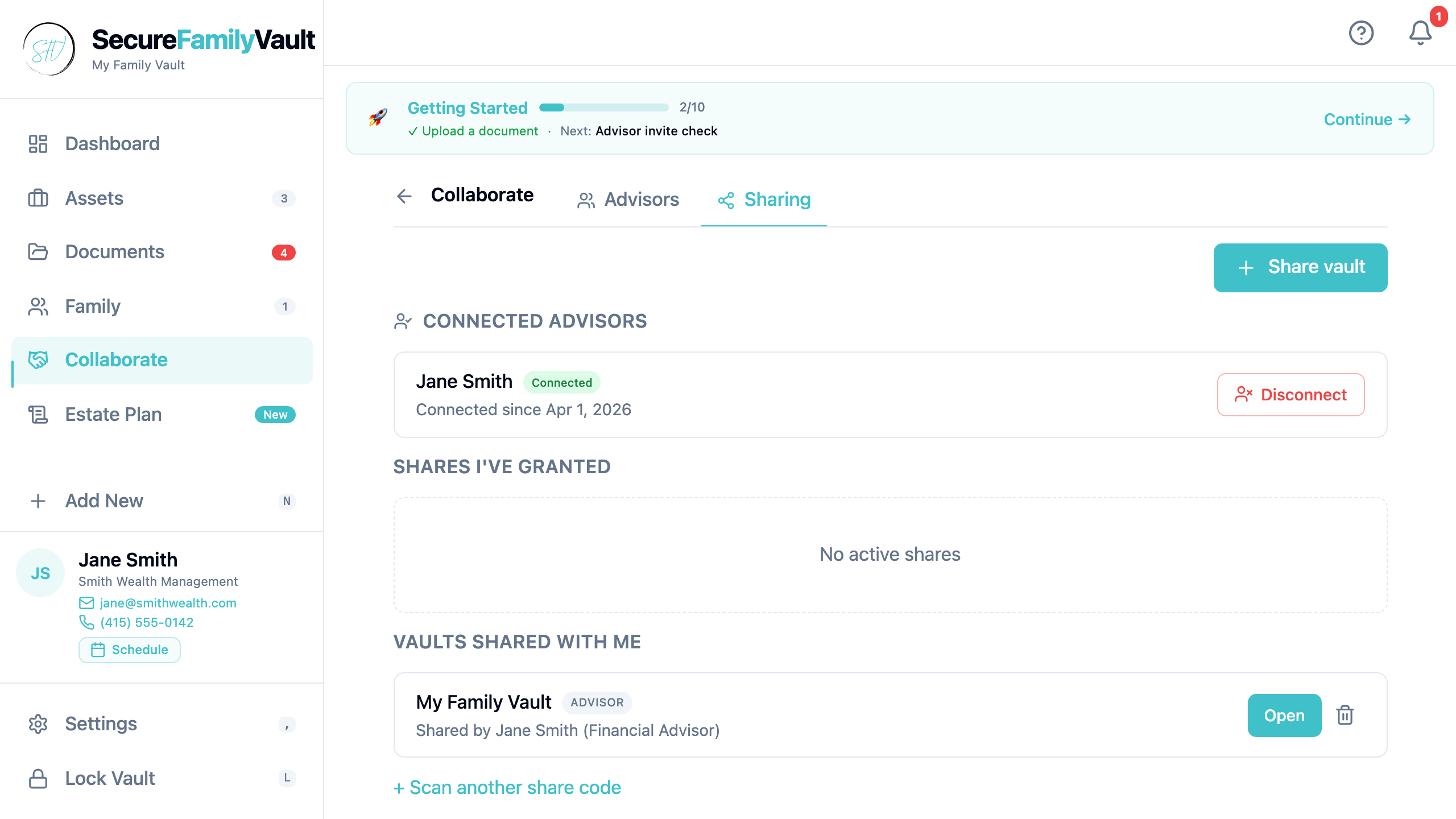
When your parent grants you access to their vault, it's read-only by default. You can see assets, beneficiary allocations, the will, important documents. You can't change anything. They keep full control of what's shared and can revoke at any time.
And because the vault is encrypted on their device, we still can't read it — your access is end-to-end encrypted between you and them, not mediated by our servers.
How to bring it up
Three ways to start the conversation.
1. Lead by doing it yourself.
Open your own vault. Spend twenty minutes filling in your own assets, will, and family info. Then mention it casually — "I just set up this vault for our stuff, you should check it out for yours."
2. Send the parent-focused page.
/for-parents is written for them, not us. Forward the link with a short note: "I came across this and thought of you — they make it really easy."
3. Make it a project.
Block out a Saturday afternoon. Sit at the kitchen table together. Help them open a vault, enter what they remember, and download their Emergency Kit. It's a meaningful afternoon — and dramatically less awkward than the alternative version of this conversation.
Two vaults. Two generations. One quiet relief.
Open one for yourself. Send the link to your parents. Both are free, both stay on their respective devices, both make the future a little less hard.